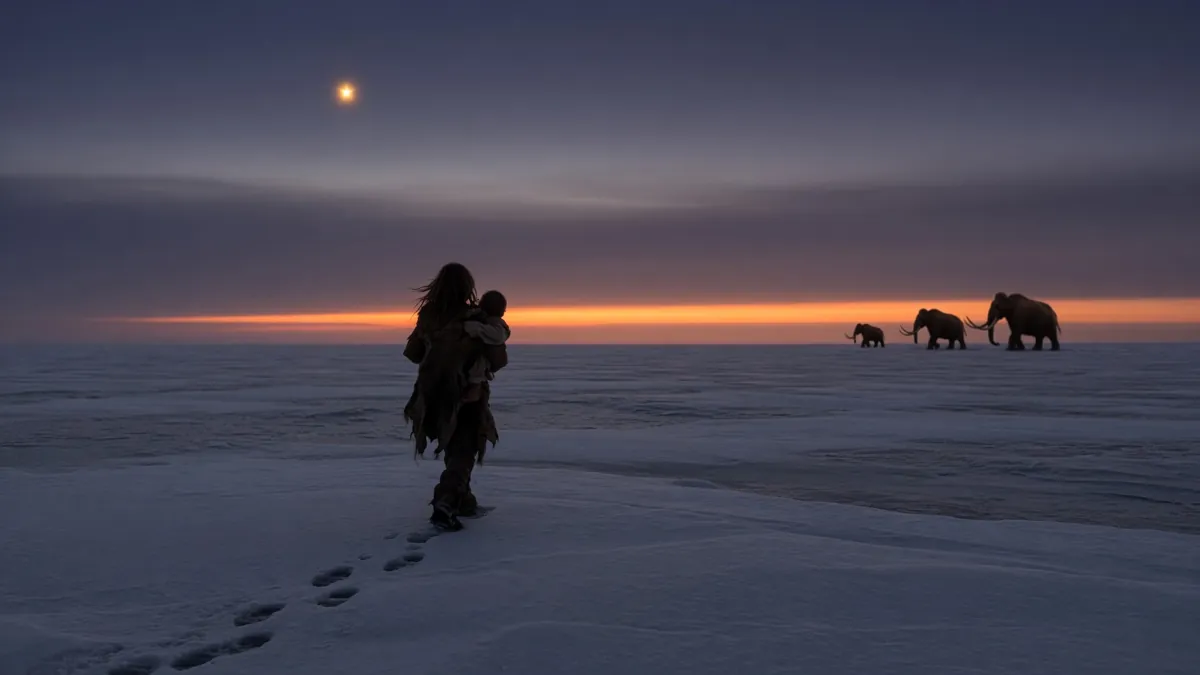
A parent shifts a tired child onto one hip. It is one of the most ordinary gestures a human body can make — and one of the oldest. On the floor of a dried-up lake in New Mexico, a line of fossil footprints appears to record that exact gesture: a young person carrying a small child across wet ground, setting the child down to rest, lifting it again, and later returning along the same path, alone. The footprints are around 23,000 years old — and for most of the last century, they should not have existed at all.
The rule that said "impossible"
For decades, the peopling of the Americas had a confident answer. The first people were the Clovis culture, known for their elegant fluted spear points, who appear in the record about 13,000 years ago. "Clovis-first" hardened into something close to law. The reasoning was sound: at the peak of the last Ice Age, two enormous ice sheets — the Laurentide and the Cordilleran — buried the north of the continent, closing the way south like a frozen door. Until that door opened, the thinking went, no one on foot could pass. So 13,000 years became a ceiling, and anything older was treated as a dating error.
White Sands and the "ghost tracks"
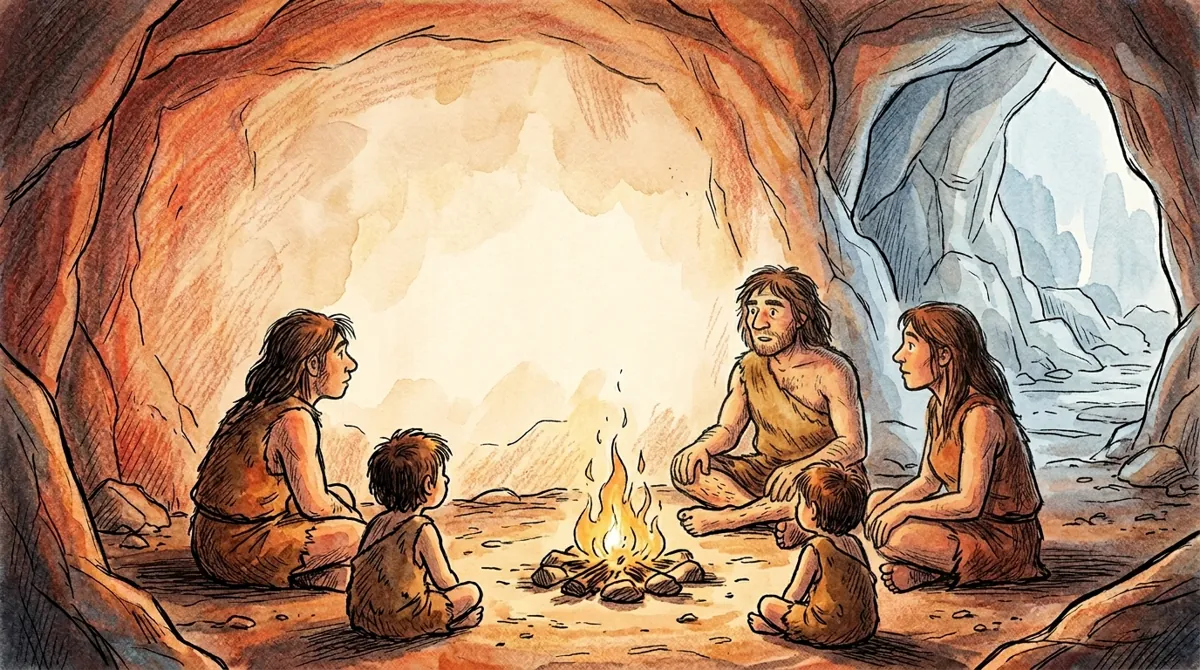
Today, White Sands is the largest gypsum dunefield on Earth, a blinding white sea in the Tularosa Basin. In the Ice Age it was wet: a wide, shallow lake known as Lake Otero, fringed with soft grey mud. Animals and people walked that mud; it dried, was buried, and slowly turned to stone. The prints surface only when the ground's moisture is just right, then fade — researchers call them ghost tracks. Strikingly, many of the human prints are small: the footprints of children and teenagers. One reading is simply that the young did the fetching and carrying then, as now — an interpretation, but a human one.
The date that silenced the room
In 2021, a team led by Matthew Bennett and colleagues published radiocarbon dates from seeds of an aquatic plant (Ruppia cirrhosa) pressed into the print layers. The ages clustered around 21,000–23,000 years ago — squarely within the Last Glacial Maximum, the coldest, harshest stretch of the Ice Age, with the "door" still shut. If correct, humans were not latecomers to the Americas. They were already deep inside the continent in the middle of the Ice Age.
Proving themselves wrong
Extraordinary claims demand extraordinary evidence, and the criticism was specific and fair. Aquatic plants can absorb "old" carbon dissolved in lake water — a reservoir effect that can make a radiocarbon date read older than the event it is meant to time. The seeds were the weak point. So in 2023, a team led by Jeff Pigati and Kathleen Springer did something rarer than most science ever attempts: they tried to break their own result. They re-dated the same layers two completely independent ways — radiocarbon on terrestrial conifer pollen (which never touches the lake's carbon problem) and optically stimulated luminescence, which measures when a grain of quartz last saw sunlight. Three different clocks, one answer: the footprints really are about 23,000 years old.
A dangerous Eden
Step into their world and it is not an empty tundra but a crowded, dangerous abundance. The lake drew everyone in. Columbian mammoths drank at the shore. Giant ground sloths the size of small cars reared up on their hind legs, claws like meat-hooks. Dire wolves and American lions worked the edges; native camels and native horses grazed the flats long before any European ship. And the tracks preserve behaviour that bones never could: one human trail shadows a giant sloth, circling and closing, while elsewhere mammoth and sloth tracks cut straight across a human path, fresh, minutes apart. This was a place where you did not leave a small child alone for long.
The smallest footprints of all
Which returns us to the carrier. The long trackway runs almost dead straight and fast; the toes bite deeper than the heels, the unmistakable signature of someone hurrying under a weight. Partway along, a second tiny set of prints appears beside the larger ones — the child, set down for a moment — then vanishes again as it is scooped back up. On the return journey, the carrier walks alone. We do not know who they were. We have their footsteps, not their bones, not their names; not whether this was a mother, a father, an older sibling or a friend. The mud kept the act, not the identity. But the act is unmistakable, and it is 23,000 years old.
What it changes — and what's still argued
If people were this far south at the Ice Age's coldest, the old "door" cannot be the whole story. Perhaps they arrived earlier, before the ice closed; perhaps they came another way entirely — down the Pacific coast by boat, the so-called "kelp highway," slipping past the ice by sea while the land route stayed shut. That part remains genuinely contested, which is exactly what healthy science looks like. The footprints themselves, however, are no longer seriously in doubt. They waited 23,000 years to tell us that we arrived earlier than we thought — and that, even then, we were carrying our children home through an uncertain world.
Sources and further reading
- Bennett, M.R., Bustos, D., Pigati, J.S., et al. (2021). "Evidence of humans in North America during the Last Glacial Maximum." Science 373: 1528–1531.
- Pigati, J.S., Springer, K.B., et al. (2023). "Independent age estimates resolve the controversy of ancient human footprints at White Sands." Science 382: 73–75.
- Bennett, M.R., et al. (2020). "Walking in mud: Remarkable Pleistocene human trackways from White Sands National Park." Quaternary Science Reviews 249: 106610.
- Bustos, D., et al. (2018). "Footprints preserve terminal Pleistocene hunt? Human–sloth interactions in North America." Science Advances 4: eaar7621.
- Erlandson, J.M., et al. (2007). "The Kelp Highway Hypothesis." Journal of Island & Coastal Archaeology 2: 161–174.
- U.S. National Park Service — White Sands National Park, "Fossilized Footprints."
Note on method: dates follow the published literature; where findings are debated — the identity of the people and the route by which they reached the Americas — this is stated plainly. These ancient people are treated as agents in their own lives, not as specimens.
Echoes of Dawn — the untold story of who we were. Watch the episode and subscribe to the channel.