Imagine you wake up tomorrow, two hundred thousand years in the past, dropped into the body of an early human at the first gray light of dawn. You have no phone, no map, no metal, and no matches — and no idea that almost everything around you wants you dead. You have exactly one job today, the only job that has ever truly mattered: stay alive until the sun goes back down. Statistically, you will not. A single day in the Stone Age would push your modern, comfortable body to a limit you have never come close to feeling. To find out what those twenty-four hours would actually do to you, we are going to live one full day as a Pleistocene hunter-gatherer — built on real archaeology and on careful studies of the last hunter-gatherer peoples alive today. They are not a perfect mirror of the ancient past, but they are the closest window we have.
Why the odds are against you
The first thing to accept is that you are not the apex predator you imagine. You have no claws, no fangs, no armor, and almost no fur to keep you warm. You are slower than nearly everything that hunts you, and once the sun sets, you are practically blind. In Man the Hunted (2005), anthropologists Donna Hart and Robert Sussman argued that for most of our history, humans were the hunted — a regular item on the Pleistocene menu, with a striking share of fossil accumulations showing predator damage. Your body needs two to three liters of water a day before your thinking starts to slip, and thousands of calories that must each be found, dug, chased, or killed. There are no doctors: a twisted ankle, an infected cut, or a rotten tooth can quietly become a death sentence.
But forget the myth that everyone simply died at thirty. Researchers Michael Gurven and Hillard Kaplan (2007) found that hunter-gatherers who survived childhood often lived into their sixties and seventies. That grim "average age" was dragged down by children dying young, not by adults collapsing in their prime. So the people beside you are not fragile — they are the toughest experts who have ever lived, and you have to keep up with them.
Dawn: waking cold and hunted
You wake on hard, bare ground, and the first thing you feel is cold. Savanna nights drop sharply, and you have no blanket — only a fire burned down to embers and the warmth of the bodies pressed around you. You are also exhausted in a way no coffee could fix. Studies of groups like the Hadza and the San (Yetish et al., 2015; Samson et al., 2017) found that across a sleeping camp, someone is almost always awake. Researchers call it the sentinel effect: staggered sleep schedules mean scattered light sleepers act as a living alarm, guarding the group through the dark. You survived the night because someone else barely slept. Now your body is already issuing one loud command: find water.
The deadliest place in your world
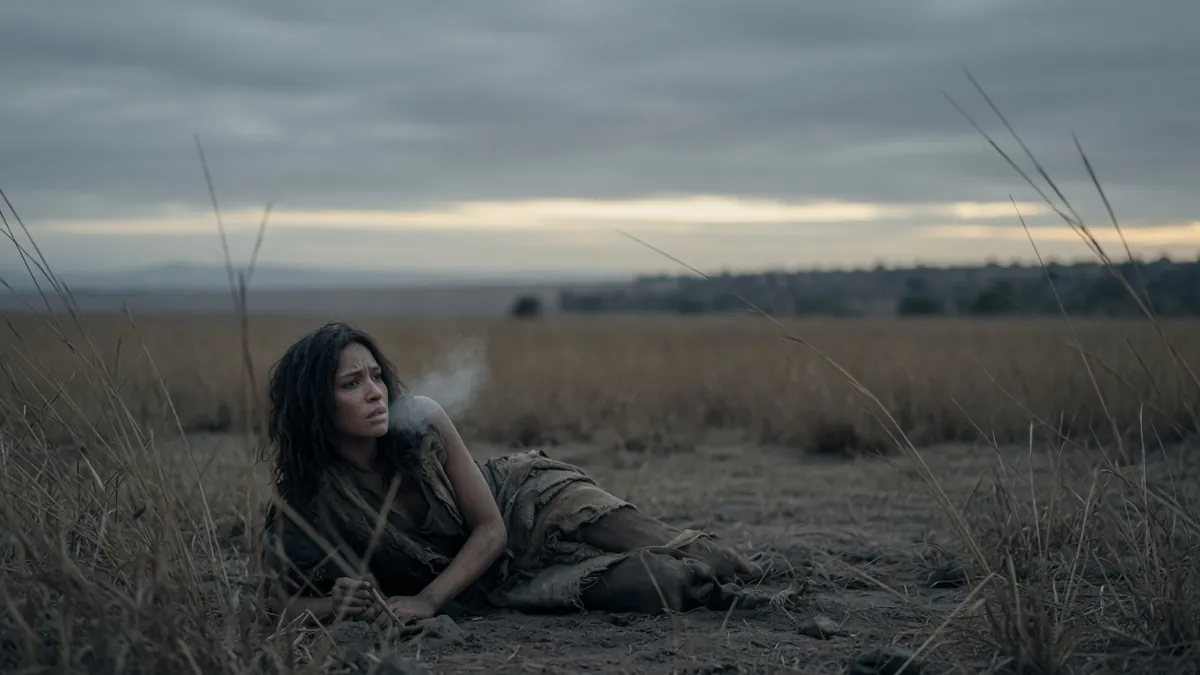
Water is your first emergency, long before food. But you cannot turn on a tap — the nearest reliable water might be kilometers away across open ground, and that water hole is the single most dangerous place in your entire world. Every animal needs it, which means every predator already knows exactly where to wait. So you move as a group, you stay low, you drink fast, and you leave even faster. You have been awake one hour, and you have already gambled your life once.
The real source of your food
Now your body demands calories — and here is the truth that surprises most people. The dramatic, spear-throwing hunt is not where most of your food comes from. Studies of living foragers (and the energetics work of Herman Pontzer and colleagues among the Hadza) show that day to day, patient gathering brings in the steadier and often larger share of the calories. So you spend hours walking, scanning, and digging for roots, tubers, nuts, and fruit. But the plants fight back: many are toxic, and a single wrong root can poison you from the inside. Every meal is a test of knowledge that took a lifetime to learn — knowledge you, the time traveler, simply do not have. And if you are truly lucky, you find honey: the richest burst of energy in your entire world.
The impossible hunt
Then, in the brutal heat of midday, comes the hunt — and humans hunt in a way that should be impossible. You cannot outrun a gazelle in a sprint; it would leave you standing. So you do not sprint. You walk, and you jog, and you simply refuse to stop. The scientists Dennis Bramble and Daniel Lieberman (Nature, 2004) showed that our bodies are built for precisely this — endurance running. Long legs, springy Achilles tendons, a head-stabilizing nuchal ligament, and millions of sweat glands let you shed heat while you keep moving. The animal cannot: it has to stop and pant in the shade to cool down, and every time it stops, you appear on the horizon again. For hours, under a punishing sun, you follow it, until its overheating body finally staggers and collapses. This is persistence hunting, and many researchers believe it is one of the oldest hunting strategies our species ever used. But it has cost you nearly everything — your water, your strength, and the entire blazing afternoon.
Nightfall, predators, and fire
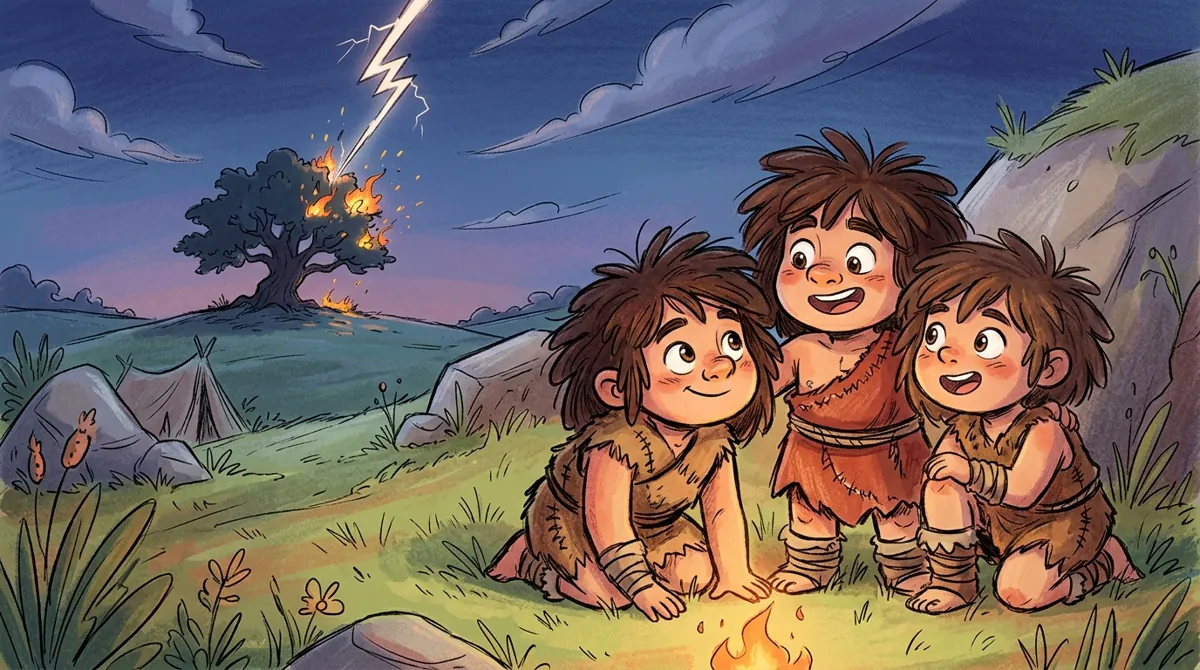
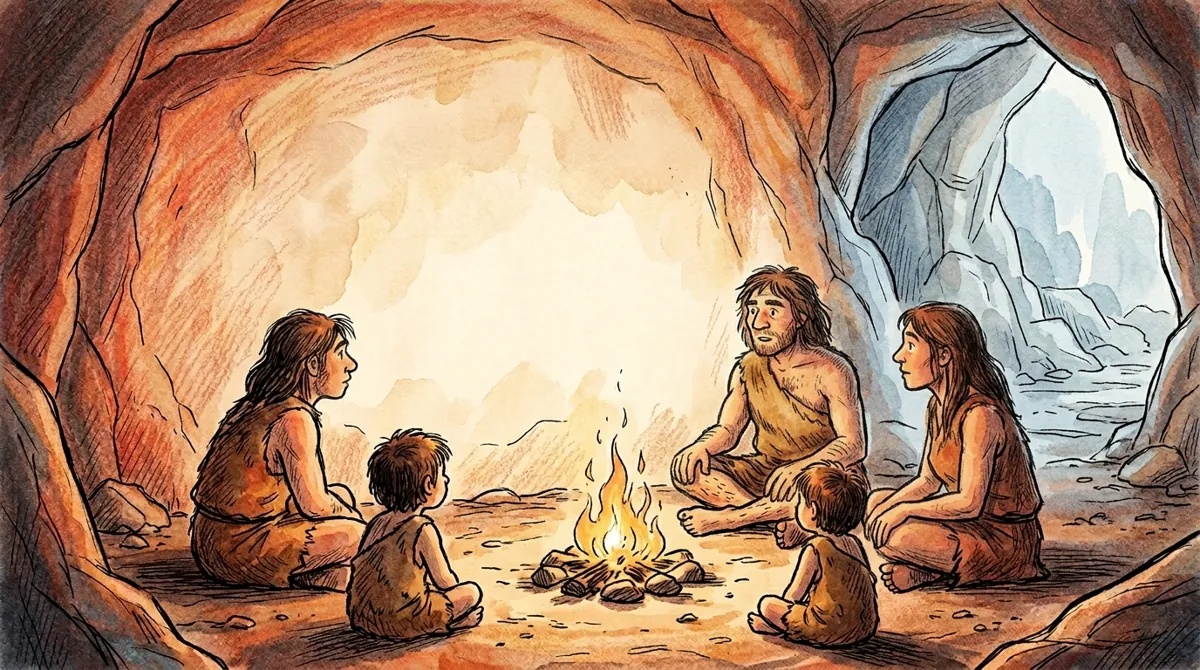
The sun drops fast, and it drags the most dangerous hour of all down with it. Dusk is when the big cats and hyenas begin to move, and your weak human night vision is already failing. But you carry one weapon they fear more than any spear: fire. Burned remains at sites like Wonderwerk Cave in South Africa (Berna et al., 2012) suggest our ancestors were using fire perhaps a million years ago. Fire cooks your food and unlocks its energy, it pushes back the freezing cold, and its light holds the predators out at the edge of the dark. So you crowd in close to the flames, hollowed out and aching, listening to the whole night breathe around you — while somewhere just beyond the firelight, something is listening back.
This was their normal
If you made it here, to this fire, on this one ordinary day, you did something genuinely extraordinary — because this was simply their normal. Every single day, for hundreds of thousands of years. You are alive right now only because an unbroken line of them won this exact day, over and over, and never once gave up. So be honest with yourself: when the cold came, and the predators circled, and your body begged you to quit — could you have survived?
Sources & further reading
- Hart, D., & Sussman, R. W. (2005). Man the Hunted: Primates, Predators, and Human Evolution. Westview Press.
- Bramble, D. M., & Lieberman, D. E. (2004). "Endurance running and the evolution of Homo." Nature, 432, 345–352.
- Pontzer, H., et al. (2012). "Hunter-Gatherer Energetics and Human Obesity." PLoS ONE, 7(7), e40503.
- Gurven, M., & Kaplan, H. (2007). "Longevity Among Hunter-Gatherers: A Cross-Cultural Examination." Population and Development Review, 33(2), 321–365.
- Berna, F., et al. (2012). "Microstratigraphic evidence of in situ fire in the Acheulean strata of Wonderwerk Cave, South Africa." PNAS, 109(20), E1215–E1220.
- Yetish, G., et al. (2015). "Natural Sleep and Its Seasonal Variations in Three Pre-industrial Societies." Current Biology, 25(21), 2862–2868.
- Samson, D. R., et al. (2017). "Chronotype variation drives night-time sentinel-like behaviour in hunter-gatherers." Proceedings of the Royal Society B, 284(1858).
Educational historical context, not a claim that any single group lived exactly like this. Modern hunter-gatherers are the best living window into the deep past, not a perfect mirror of it.