Tonight, fire feels completely ordinary. You strike a match, light a candle, or turn a knob on a stove, and a blue flame appears instantly, as if it had been waiting politely inside the wall. To modern humans, fire is convenience. But for ninety-nine percent of our evolutionary story, fire was a fragile miracle—a living entity that had to be captured, fed, protected, and carried like treasure across dangerous landscapes.
Archaeological discoveries of the last two decades are shifting our understanding of this relationship. The human story with fire is not a simple linear progression from accidental discovery to sudden mastery. It is a long, complex transition from opportunistic fire-users who "stole" fire from nature, to technological innovators who learned to create fire on demand.
Using Fire vs. Making Fire: A Cognitive Divide
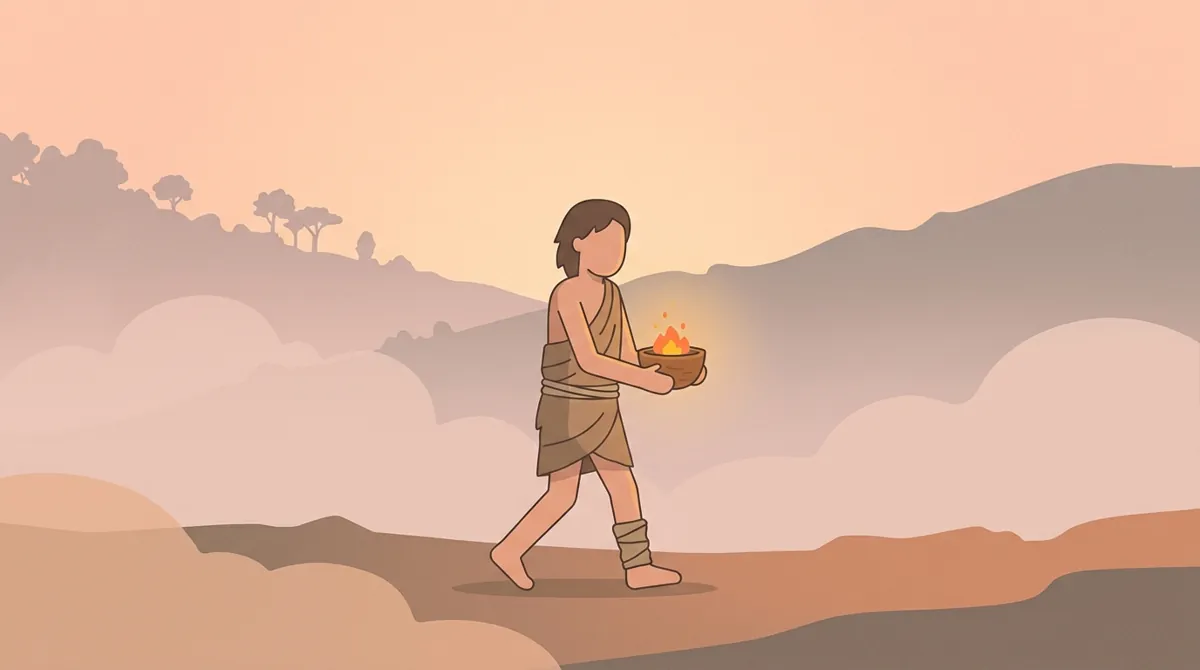
In paleoanthropology, researchers draw a sharp distinction between the habitual use of fire and the ability to generate fire. Using fire is opportunistic: a lightning strike sets a forest ablaze, and early humans gather burning branches, using them for warmth or cooking. They carry these embers with them on their journeys, guarding the coals in leather pouches or hollow horns. If the embers die, the fire is gone until the next storm.
Making fire requires a much higher level of abstract reasoning and planning. It means carrying seemingly unrelated materials—flint, iron pyrite, dry tinder—and executing a precise physical technique to invoke a spark. It represents the transition from consumers of natural processes to active engineers of chemistry.
Wonderwerk and Gesher Benot Ya'aqov: The Deep History of the Hearth
The oldest evidence for controlled fire use pushes deep into the Pleistocene. In 2012, researchers led by Francesco Berna identified microstratigraphic evidence of burned bone and ash inside **Wonderwerk Cave** in the Northern Cape of South Africa, dating back approximately one million years. Because the burned material was located deep inside the cave where lightning could not strike, it represents strong evidence that early hominins (likely *Homo erectus*) were carrying fire indoors.
At **Gesher Benot Ya'aqov** in Israel, dating to approximately 790,000 years ago, archaeologist Nira Alperson-Afil found evidence of repeated, localized burning in specific patterns. The burned seeds, wood fragments, and flint tools were clustered in distinct zones, suggesting that hominins were constructing hearths—spatial anchors for their camps. This repeated hearth use shows how fire was beginning to organize human social spaces and domestic behaviors.
| Site | Age | Key Evidence | Hominin Involved |
|---|---|---|---|
| Wonderwerk Cave (South Africa) | ~1,000,000 BP | Deep cave ash, micro-stratified burned bone and plant material. | Homo erectus / early Homo |
| Gesher Benot Ya'aqov (Israel) | ~790,000 BP | Spatially distinct burning zones, cluster of heated tools and seeds. | Homo erectus / Homo heidelbergensis |
| Barnham, Suffolk (England) | ~415,000 BP | Heated clay hearths, cracked flint, presence of imported iron pyrite. | Early Neanderthals (Homo heidelbergensis) |
The Barnham Breakthrough: Did Neanderthals Make Fire?
The transition to active fire-making has traditionally been attributed exclusively to modern *Homo sapiens*. However, recent excavations at **Barnham** in Suffolk, England, have challenged this view. In layers dating to approximately 415,000 years ago, archaeologists uncovered heated clay, burned flint tools, and—most importantly—fragments of **iron pyrite** (commonly known as fool's gold).
Iron pyrite is not native to the immediate Barnham geology; it had to be brought there. When struck against hard flint, iron pyrite throws hot, long-lasting sparks, capable of igniting dry tinder. The presence of imported pyrite alongside heated flints strongly suggests that early Neanderthals (or their direct ancestor, *Homo heidelbergensis*) were carrying "fire kits." They were not waiting for the sky to strike; they had decoded the fire equation.
The Social Spark
The ability to make fire was the ultimate survival security. It allowed hominins to expand into colder, wetter European landscapes where wildfires were rare. But fire’s greatest gift was social. It made the night a community space, bringing people together around the hearth. In that circle of warmth, they repaired tools, shared meals, taught their children, and built the collaborative networks that formed the bedrock of human culture.
References
- Berna, F., et al. (2012). *Microstratigraphic evidence of in situ fire in the Acheulean strata of Wonderwerk Cave, South Africa.* **Proceedings of the National Academy of Sciences**, 109(20), 1215-1220.
- Alperson-Afil, N. (2008). *Continual fire-making by hominins at Gesher Benot Ya'aqov, Israel.* **Quaternary Science Reviews**, 27(17-18), 1733-1739.
- Roebroeks, W., & Villa, P. (2011). *On the earliest evidence for habitual use of fire in Europe.* **Proceedings of the National Academy of Sciences**, 108(13), 5209-5214.
- Wrangham, R. (2009). *Catching Fire: How Cooking Made Us Human.* **Basic Books**.