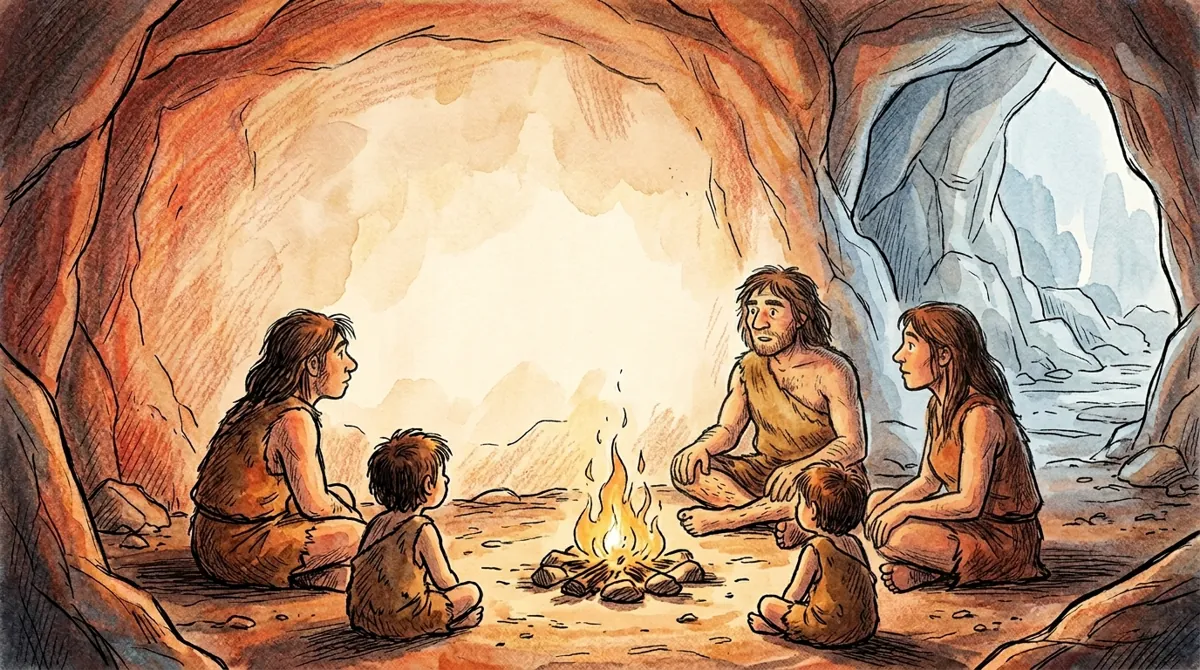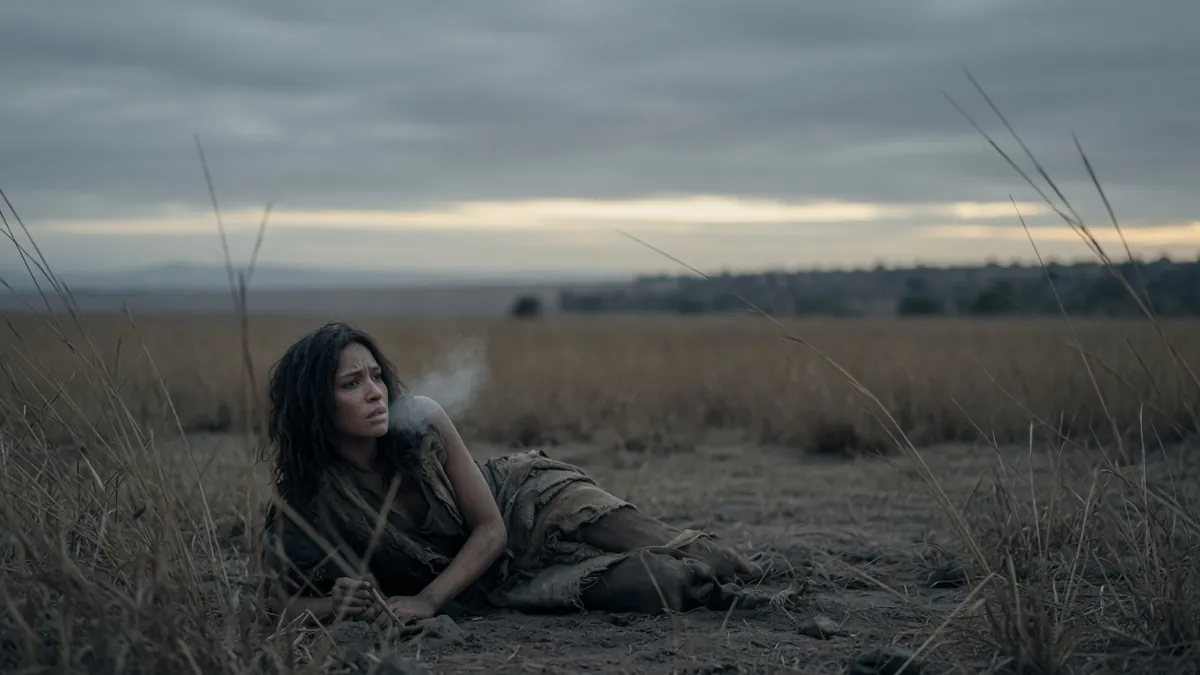
There are eight billion of us now. It is easy to assume our species was always destined to fill the planet. But written into the DNA of every living human is the signature of a very different past — a time when our ancestors were not a global success story but a small, scattered, endangered population, closer to extinction than to empire. Genetics suggests that, at least once, the human line came terrifyingly close to ending before it really began.
This is one of the hardest stories in human evolution to tell, because we have no bones from the worst of it, no campfire, no cave wall — only the faint echo a population crash leaves behind in modern genomes. It is also one of the most contested. So let's tell it carefully: what the genetics seems to show, what it might mean, and why serious scientists still argue about it.
How DNA remembers a catastrophe
When a population shrinks dramatically, it carries less genetic diversity through the bottleneck — only the variation present in the survivors makes it to the other side. Generations later, that loss is still detectable. By modeling how the diversity in living genomes must have changed over deep time, researchers can infer roughly how large the breeding population was at different points in the past. The genome becomes a kind of ledger of every boom and every near-miss.
Methods like the PSMC (pairwise sequentially Markovian coalescent) pioneered this approach, reconstructing ancient population sizes from a single genome. More recent tools push the inference further back — and that is where the most dramatic claim comes from.
The claim: roughly 1,280 survivors, for over a hundred thousand years
In 2023, a team led by Wangjie Hu, Yi-Hsuan Pan and colleagues published an analysis in Science using a method they call FitCoal. Their result was startling: between about 930,000 and 813,000 years ago, during the Early-to-Middle Pleistocene transition, the ancestral human breeding population may have collapsed to around 1,280 individuals — and stayed that small for roughly 117,000 years.
If that is right, our ancestors spent something like 1,200 human generations balanced on a knife's edge, a single bad century away from disappearing. The authors note the timing overlaps with a harsh swing in global climate, and even speculate the squeeze could relate to events in the human family tree around that period. It would be, quite literally, the narrowest survival story our lineage ever lived.
Why scientists argue about it
Extraordinary claims get extraordinary scrutiny, and this one has. Several researchers have questioned whether the FitCoal method can reliably detect such an ancient, specific bottleneck, arguing that different modeling assumptions, or the structure of ancient populations spread across Africa, can produce similar genetic signatures without a single dramatic crash. Others point out that the African fossil and archaeological record of that period does not obviously show a near-extinction.
This is not a weakness of the story — it is the story. The honest position today is: the genetic signal of a deep, severe bottleneck is real and intriguing, but its exact size, timing, and cause remain debated. Science here is doing exactly what it should — disputing the evidence in the open.
A different, later squeeze: the Toba question
The deep Pleistocene bottleneck shouldn't be confused with another famous near-miss: the idea that the Toba supereruption around 74,000 years ago throttled human numbers. That "Toba catastrophe" hypothesis is also contested — much archaeological evidence suggests populations in some regions weathered Toba better than the strongest version of the theory predicts. Two separate, still-argued chapters; one recurring theme: our ancestors repeatedly lived through conditions that could have erased them.
Why a near-extinction is, oddly, a story of strength
It is tempting to read all this as fragility. But survive it we did. A species that can drop to a small remnant and still come back carries something durable — flexible behavior, cooperation, the ability to share knowledge and move. The bottleneck, whatever its precise shape, is a reminder that we are not the inevitable winners of evolution. We are the descendants of small bands who held on. The diversity we lost in the squeeze is the price of admission to everything that came after.
Sources & further reading
- Hu, W., Hao, Z., Du, P., Di Vincenzo, F., Manzi, G., Cui, J., Fu, Y.-X., Pan, Y.-H., Li, H. (2023). "Genomic inference of a severe human bottleneck during the Early to Middle Pleistocene transition." Science 381(6661), 979–984. doi:10.1126/science.abq7487.
- Commentary & critiques of the FitCoal bottleneck inference in Science and subsequent technical responses (on whether ancient population structure can mimic a bottleneck signal).
- Li, H. & Durbin, R. (2011). "Inference of human population history from individual whole-genome sequences." Nature 475, 493–496 (the PSMC method).
- Ambrose, S. H. (1998). "Late Pleistocene human population bottlenecks, volcanic winter, and differentiation of modern humans." Journal of Human Evolution 34, 623–651 (the Toba hypothesis).
- Reviews questioning a strong Toba bottleneck (archaeological continuity studies at sites such as Jwalapuram and in southern Africa).
Method note: population sizes inferred from DNA are model-dependent estimates with wide uncertainty, not headcounts. The ~1,280 figure and its timing are a specific, debated result — treated here as a leading hypothesis, not settled fact.
Echoes of Dawn — the story of us, before history was written. Watch the episode and subscribe.