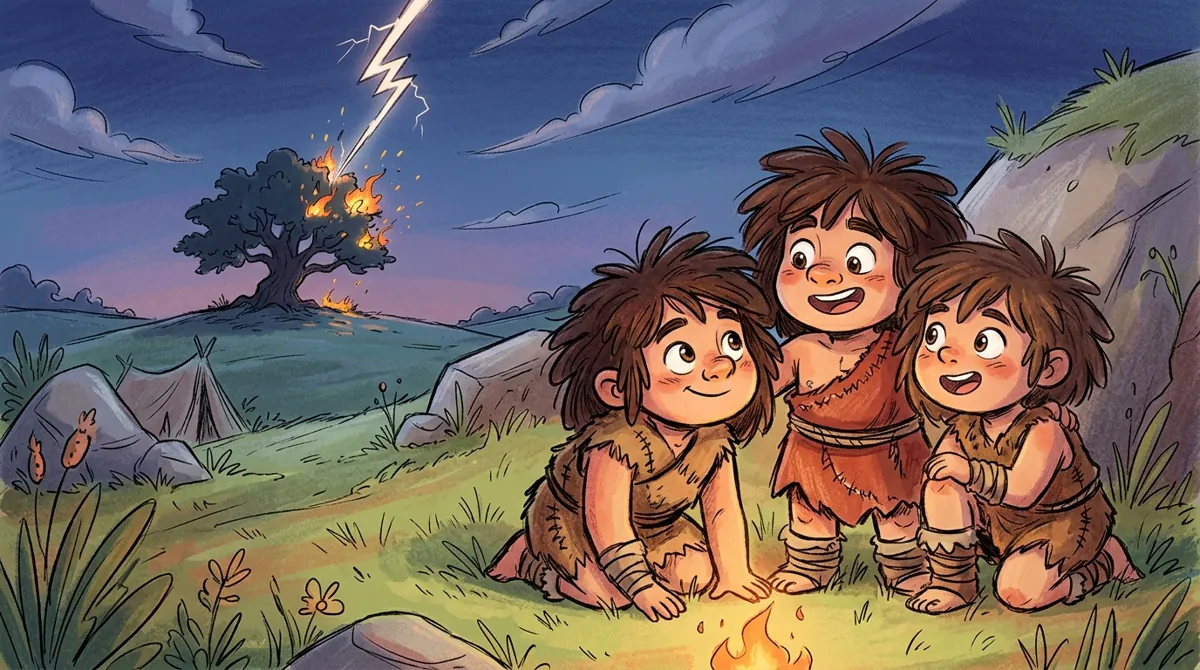
It is late at night. Your phone vibrates on the nightstand with an email notification from your boss. Instantly, your chest tightens, your breathing goes shallow, and a wave of heat washes over your neck. Your heart begins to hammer against your ribs as if your life is in immediate, physical danger. Yet, you are in a locked room, under a warm blanket, completely safe. Why does your body react to a digital line of text the same way it would react to a predator in the dark? To understand your modern anxiety, we have to travel back two million years. Your body isn't broken; it is simply running savanna software in a digitized world.
Dismantling the apex hunter myth
We love to imagine our earliest ancestors as brave, spear-wielding apex predators who dominated the wild. But the archaeological reality is far more humbling, and far more terrifying: for the vast majority of our evolutionary journey, humans were not the hunters—we were the prey. In the dry savanna of the Pleistocene epoch, early hominids were small, slow, and soft. We had no claws to tear flesh, no fangs to fight back, and no thick fur to protect us. We shared the grass with saber-toothed cats twice the size of modern lions, packs of giant hyenas, and massive prehistoric birds.
In their seminal research, the anthropologists Donna Hart and Robert Sussman (*Man the Hunted*, 2005) estimated that between 6% and 10% of early human fossils show clear evidence of predator attacks. For millions of years, the sound of a snapped twig in the twilight was a literal matter of life and death, and our ancestors' survival depended on group cohesion, defensive tool use, and hyper-vigilance.
The fossils of prehistoric terror
The fossils we have left behind still bear the marks of this ancient predation. Consider the famous **Taung Child**. Discovered in South Africa in 1924, this fossilized *Australopithecus africanus* skull belonged to a three-year-old child who lived 2.5 million years ago. For decades, scientists debated what killed this ancient toddler. In 2006, the paleoanthropologist Lee Berger made a chilling discovery: by comparing the skull to modern prey remains accumulated by raptors, he found distinct orbital floor puncture wounds and skull damage matching the talons of a prehistoric crowned eagle. The child had been swept into the sky right off the savanna floor.
Or consider skull **SK 54**, found in the Swartkrans cave of South Africa, belonging to a young hominid who lived over 1.5 million years ago. The top of the skull features two neat, circular holes. The taphonomist C. K. Brain demonstrated that the spacing of these holes perfectly matches the lower canine teeth of a fossilized leopard. The predator had killed the juvenile, dragged the carcass up into a tree overhanging the cave shaft to avoid scavengers, and the skull eventually dropped down into the cave to fossilize.
The neuroscience of fear: the 12ms low road
To survive in a landscape where death could strike from the grass or the sky, our brains developed a hyper-sensitive threat-detection system. The neuroscientist Joseph LeDoux (*The Emotional Brain*, 1996) mapped how this system operates. When your senses pick up a potential danger, the signal travels to the thalamus, where it splits into two pathways:
- The Low Road (Direct Pathway): Thalamus directly to the amygdala. This pathway is incredibly fast—taking roughly 12 milliseconds—but crude. It triggers the fight-or-flight response (adrenaline, cortisol) before your conscious mind is even aware of what happened.
- The High Road (Indirect Pathway): Thalamus to the sensory cortex, and then to the amygdala. This pathway is slower and logical, consciously verifying whether the threat is real or a false alarm.
Evolution favored the Low Road. Milliseconds meant the difference between survival and death, which is why your body reflexively jumps when you see a curved stick in the grass, long before your conscious High Road realizes it isn't a snake.
Error Management Theory: why we are paranoid
This survival software operates on a specific mathematical logic that evolutionary psychologists Martie Haselton and David Buss (2000) call Error Management Theory. In a survival situation, your threat-detection engine can make two types of errors:
- Type I Error (False Positive): You assume a rustle in the grass is a leopard, panic, and run. The cost is extremely low—a brief spike in heart rate and a few lost calories.
- Type II Error (False Negative): You assume the rustle is just the wind when it is actually a leopard. The cost is absolute—you are eaten alive, and your evolutionary line ends.
Because the cost of a missed threat was fatal, natural selection heavily biased the human brain to prioritize false alarms. We are the descendants of the hominids who ran from the wind.
The modern mismatch
Today, we have built safe, climate-controlled cities, paved over the tall grass, and driven the predators to near extinction. But we could not delete the Pleistocene survival software from our skulls. Your amygdala still scans your surroundings for life-or-death threats every single second. Because it can no longer find saber-toothed cats, it projects that ancient, biological panic onto modern, digital equivalents: a late-night email, a critical comment on social media, or an awkward silence in a meeting.
In a small hunter-gatherer tribe, social exclusion or status loss meant ostracism—which was a death sentence. Therefore, your brain processes social evaluation and corporate deadlines with the same life-or-death intensity as a physical predator. Your modern anxiety is not a sign that you are broken or weak; it is the ultimate proof that your ancestors were the most attentive, resilient survivors on earth. You cannot delete this prehistoric software, but you can take your power back by finally understanding what it is trying to do.
Sources and further reading
- Donna Hart & Robert Sussman, Man the Hunted: Primates, Predators, and Human Evolution (2005) — hominid prey evidence.
- Lee R. Berger, "Brief Communication: Predatory bird damage to the Taung Child skull," American Journal of Physical Anthropology (2006).
- C. K. Brain, The Hunter or the Hunted? An Introduction to African Cave Taphonomy (1981) — Swartkrans skull SK 54 analysis.
- Joseph LeDoux, The Emotional Brain (1996) — the amygdala's fear pathways.
- Martie G. Haselton & David M. Buss, "Error Management Theory: A new perspective on cognitive biases," Journal of Personality and Social Psychology (2000).
Note: this is evolutionary and historical context, not medical or psychological advice. While predation was a major evolutionary pressure shaping our threat-detection pathways, hominids also adapted through complex social bonds, communication, and cooperative tool-making.
Echoes of Dawn — the story of us, before history was written. Watch the episode and subscribe.