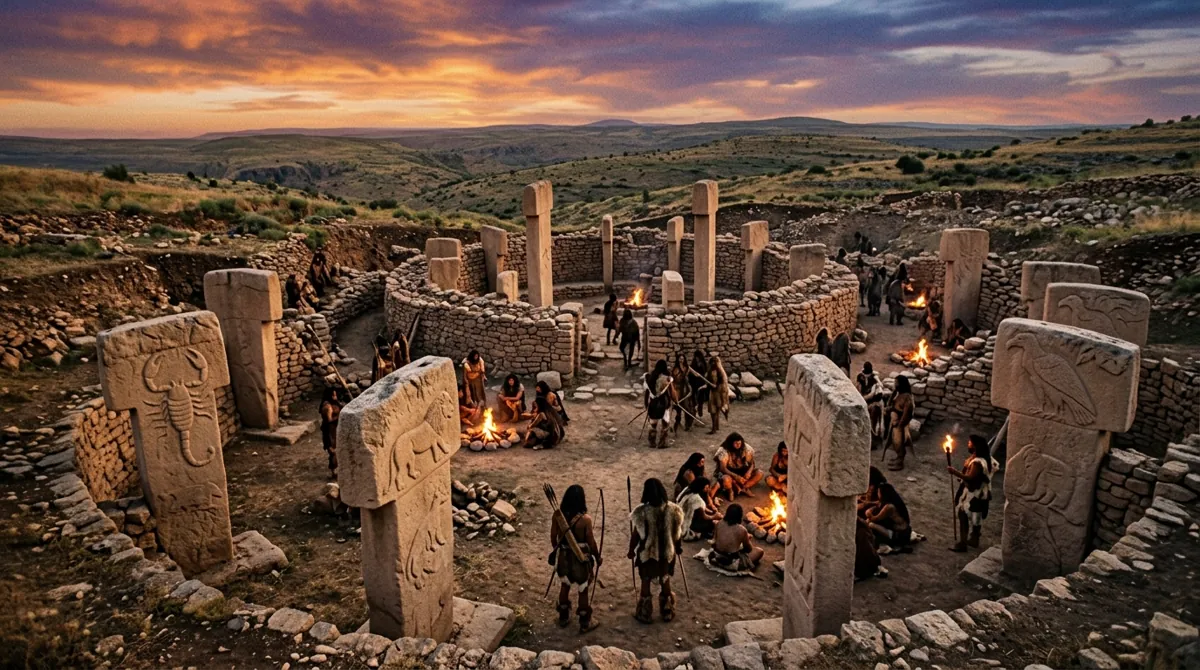
Six thousand years before the first stones were raised at Stonehenge, and long before the Great Pyramids of Giza rose from the Egyptian sands, a monumental architectural project was underway in the rolling hills of southeastern Turkey. Nomadic hunter-gatherers carved giant T-shaped limestone monoliths weighing up to fifty tons each from solid bedrock, hauling them across the landscape to erect massive concentric stone circles. This is Göbekli Tepe — the oldest known temple complex in human history.
Dated to cêrca of 9500 BC, Göbekli Tepe did not merely add a new chapter to ancient archaeology; it completely upended the accepted narrative of how human civilization began.
The Old Model: Agriculture First, Temples Later
For over a century, the standard economic and anthropological theory of human development was linear and logical. The narrative taught in textbooks stated that:
- Humans invented agriculture by domesticating wild grains and animals.
- Food surpluses allowed mobile hunter-gatherers to settle down into permanent agrarian villages.
- Permanent settlements led to population growth, social stratification, and specialized labor.
- Only after cities and labor specialization emerged did human societies have the spare time and organization to build monumental temples and sacred complexes.
Göbekli Tepe shattered this paradigm. When German archaeologist Klaus Schmidt began excavating the artificial hill in 1994, he expected to find a modest medieval burial ground. Instead, he uncovered massive megalithic rings preserved beneath meters of soil. And when archaeologists analyzed the organic sediment, they discovered something astonishing: there were no domesticated grains, no domesticated animal bones, no permanent houses, no cooking hearths, and zero pottery.
Nomads Engineering Megaliths Without Metal
The builders of Göbekli Tepe were not settled farmers; they were nomadic hunter-gatherers who survived by hunting wild gazelles, wild boars, and gathering wild Einkorn wheat. Yet, without metal chisels, wheels, or beasts of burden, hundreds of independent hunter-gatherer bands coordinated to engineer the largest stone construction project the world had ever seen.
Using flint picks and wooden wedges soaked in water, they chiseled deep channels around giant blocks of limestone in nearby quarries. Once freed, the 10 to 50-ton monoliths were dragged using wooden rollers, hemp ropes, and brute human muscle to the hilltop site. The T-shaped pillars were not abstract geometric shapes; they were stylized, featureless human representations, complete with carved arms, hands draped over belt buckles, and fox-skin loincloths.
Sacred Feasts and the Origin of Agriculture
Why did mobile bands of hunter-gatherers gather by the hundreds in an arid Turkish landscape? Excavations uncovered tens of thousands of butchered wild gazelle and aurochs bones, alongside massive stone vats capable of holding up to 40 gallons of liquid. Chemical analysis of the residue inside these vats revealed traces of oxalate — evidence of early wild grain beer fermentation.
Göbekli Tepe served as a central regional sanctuary and feasting ground. Hunter-gatherers gathered seasonally to perform rituals, trade goods, arrange marriages, and honor their ancestors. To feed hundreds of workers constructing these stone sanctuaries, the surrounding wild grains were harvested in unprecedented quantities.
Genetic tracking of modern domesticated Einkorn wheat (Triticum monococcum) has traced its exact progenitor to the wild slopes of Karaca Dağ — a volcanic mountain located just 20 miles from Göbekli Tepe. The imperative to build and gather at the temple forced humans to domesticate wheat. In short: the temple came first, then agriculture.
The Intentional Burial
Around 8000 BC, after nearly 1,500 years of active use, the builders did something even more mysterious: they deliberately backfilled the entire complex. Thousands of tons of dirt, gravel, and animal bones were dumped into the enclosures, sealing the sacred pillars like a massive underground time capsule until Klaus Schmidt's shovel struck stone in 1994.
Today, ongoing excavations at nearby sites like Karahan Tepe reveal that Göbekli Tepe was part of a widespread, sophisticated Pre-Pottery Neolithic culture that redefined the trajectory of our species over eleven thousand years ago.
Sources and Scientific References
- Schmidt, Klaus. Göbekli Tepe: A Stone Age Sanctuary in South-Eastern Anatolia. Miras Publication, 2012.
- Heun, M., et al. Site of Einkorn Wheat Domestication Identified by DNA Fingerprinting. Science 278 (1997).
- Peters, J., & Schmidt, K. Animals in the symbolic world of Pre-Pottery Neolithic Göbekli Tepe. Anthropozoologica (2004).
- UNESCO World Heritage Centre. Göbekli Tepe Nomination Dossier No. 1572 (2018).