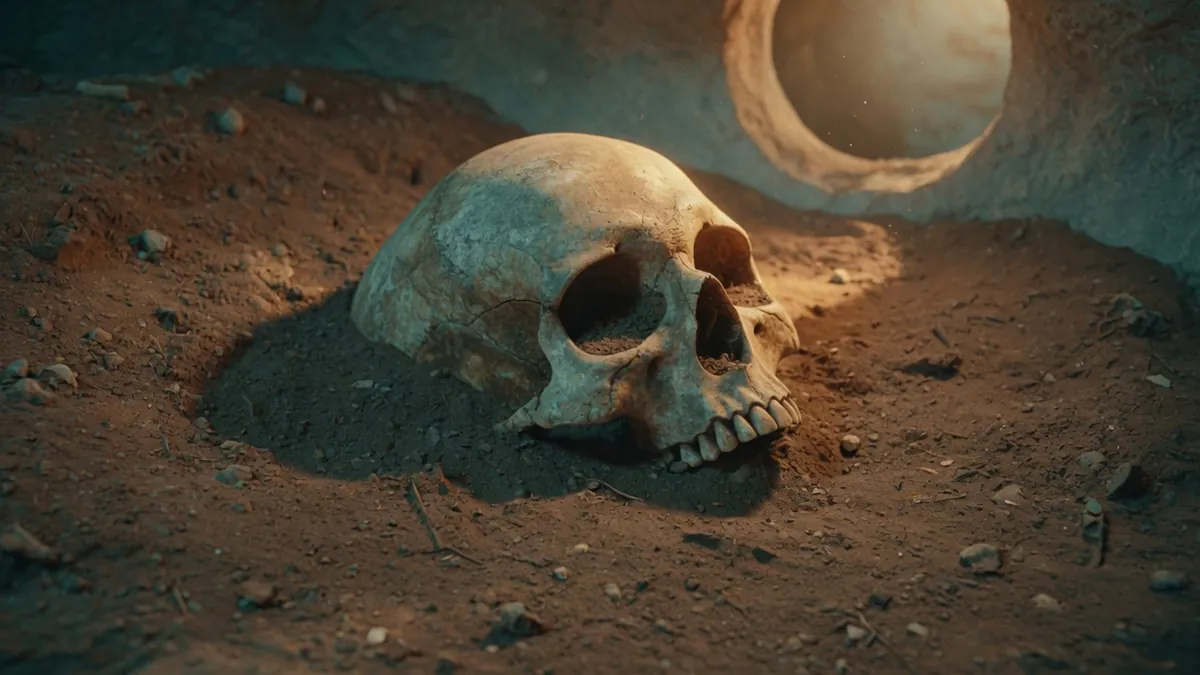
Imagine crawling through total, suffocating darkness, thirty meters beneath the surface of the Earth. You are wedged inside a vertical limestone chimney known as the "Superman Squeeze" in South Africa’s Rising Star cave system. The jagged rock walls press against your chest and back so tightly that you can only advance by exhaling all the air from your lungs, flattening your ribcage, and wriggling forward an inch at a time. The gap is just eighteen centimeters wide—barely seven inches.
In September 2013, two amateur cavers—Rick Hunter and Steven Tucker—pushed through this terrifying squeeze, dropped down a twelve-meter cliff called the Chute, and stepped into a hidden vault known as the Dinaledi Chamber. When they angled their headlamps down toward the dirt floor, they didn’t find ancient stalagmites or animal dens. They found a subterranean bone yard littered with skulls, jaws, arm bones, and delicate hands.
The Discovery That Shattered African Paleoanthropology
When paleoanthropologist Lee Berger assembled an elite team of underground excavators, what they pulled out of that cave stunned the scientific world: over fifteen hundred fossilized bones representing at least fifteen individuals. It was the single largest discovery of hominin fossils ever made on the African continent.
As anatomists pieced together the skeletons, they realized they had uncovered a brand-new species of human ancestor: Homo naledi. Standing under five feet tall, Homo naledi walked upright like us and crafted tools with dexterous hands—yet possessed a brain measuring just 465 to 560 cubic centimeters, no bigger than an orange.
Anatomical Mosaic: Modern Legs, Primitive Brain
To understand why Homo naledi sent shockwaves through paleoanthropology, look at its extraordinary anatomical mosaic:
- Legs and Feet: Nearly indistinguishable from modern humans, featuring a pronounced arch, an aligned big toe, and a sturdy heel built for terrestrial walking.
- Hands and Wrists: Proportions adapted for high-precision gripping—the exact biomechanical setup needed to manufacture and manipulate complex stone tools.
- Shoulders and Ribcage: Angled upward like an ape's, suited for tree climbing, with a flared lower ribcage resembling primitive australopithecines like Lucy.
- Cranial Capacity: Between 465 and 560 cm³—less than half the size of Homo erectus and comparable to a chimpanzee.
For over a century, the foundational paradigm of human evolution was simple: brain size drives complexity. Anthropologists believed big brains were mandatory for abstract thought, fire control, and ritual behavior. When researchers first analyzed Homo naledi's primitive skull, they assumed it lived two or three million years ago.
The Shocking Age: 250,000 Years Old
In 2017, a team of geologists published the definitive age of the Homo naledi fossils using electron spin resonance, uranium-thorium dating, and paleomagnetic analysis. The fossils were not two million years old. Homo naledi lived between 236,000 and 335,000 years ago.
Two hundred and fifty thousand years ago, early Homo sapiens were already evolving in Africa. While our direct ancestors were hunting game with hafted spears, a small-brained hominin with ape-like shoulders was roaming the hills of the Cradle of Humankind at the exact same time.
The Mortuary Burial Controversy
Eliminating every natural possibility—flash floods, predator drag marks, or accidental death traps—left Lee Berger’s team with a groundbreaking hypothesis: Homo naledi was deliberately carrying its dead through pitch-black subterranean conduits and depositing them in a secluded underground vault.
In 2022 and 2023, excavation teams announced further evidence: soot deposits coating limestone ceilings, charcoal from hearth-like pits suggesting torch usage, and deeply carved geometric cross-hatch engravings etched into dolomite pillars near the entry to the burial chambers.
While skeptics in the Journal of Human Evolution argue that micro-stratigraphic proof for grave digging remains unverified, Homo naledi has forever shattered the linear ladder model of human evolution. Deep inside the dark chambers of the Rising Star cave, an orange-brained ancestor left us a humbling reminder: we were never the only ones who sought light in the dark.