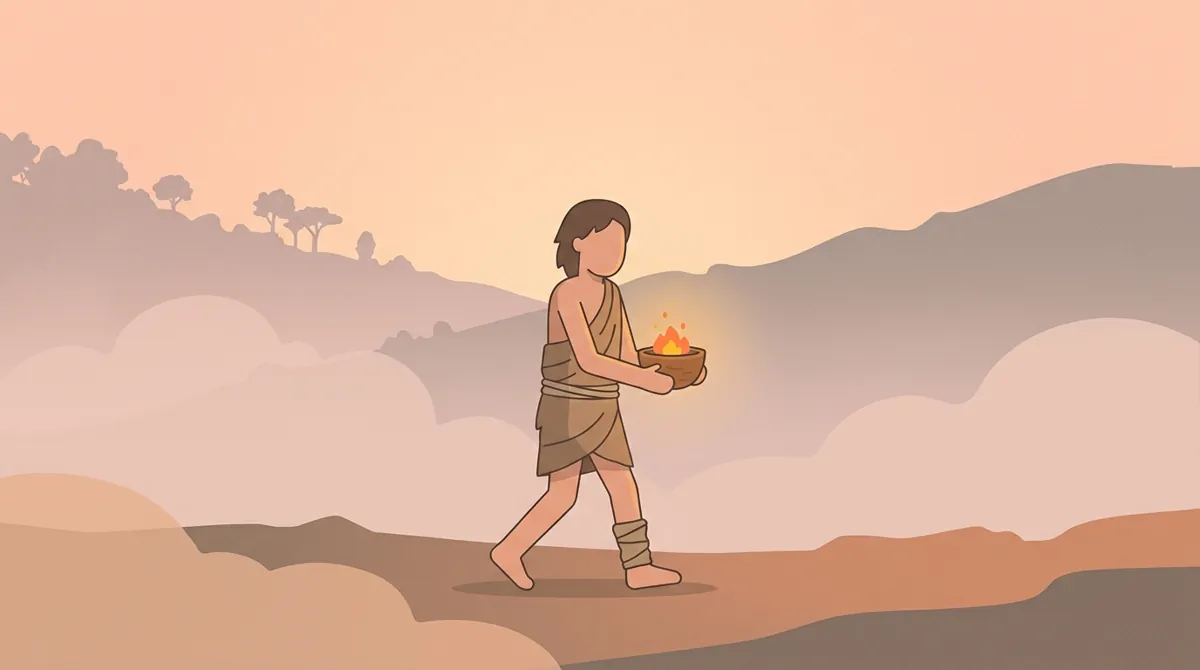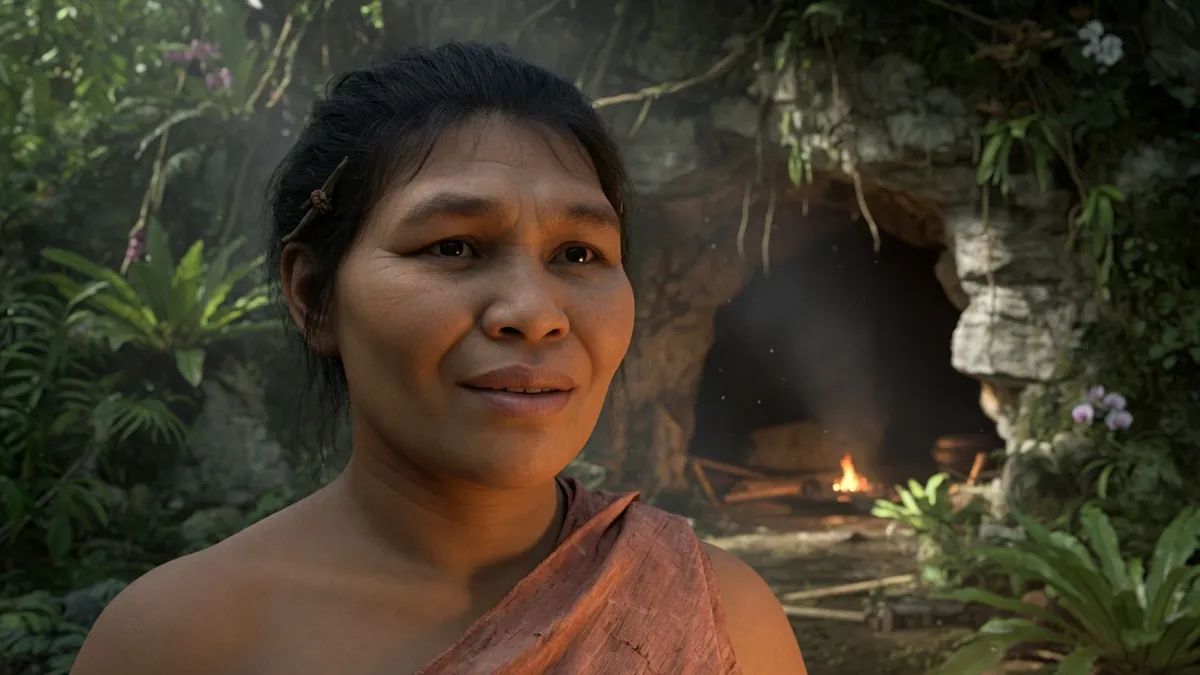
We treat hobbits as fantasy. But a real human species, barely one meter tall, once lived on a single Indonesian island, made tools, and hunted strange dwarfed animals. They are not a legend. They are a fossil.
Their name is Homo floresiensis, and their island home reads like a fairy tale written by evolution: small humans, small elephants, and dragons.
The discovery at Liang Bua
In 2003, in a cave called Liang Bua on the island of Flores, researchers uncovered the skeleton of a tiny adult human, about a meter tall, with a brain closer in size to a chimpanzee's than to ours. Yet stone tools and butchered animal bones showed this was a capable toolmaker, not a curiosity. A new human species had been found.
The island that shrinks giants
Islands do strange things to bodies. Cut off with limited food, large animals tend to shrink over generations, and small animals can grow. Flores had dwarf elephants (Stegodon) the size of a large pony, alongside giant rats, storks and Komodo dragons. The leading explanation for the hobbits is the same rule applied to humans: insular dwarfism, an ancestral human shrunk by island life.
A world of small humans and dwarf elephants
Picture the scene the bones describe: small, clever people hunting dwarf elephants, watching for giant lizards, knapping stone in the mouth of a limestone cave. They survived on Flores for a very long time, and revised dating suggests they persisted until roughly fifty thousand years ago, around the time modern humans were spreading through the region.
Did we meet them?
We cannot yet prove that our ancestors met the hobbits, and we should be careful with the island's Ebu Gogo folklore about small wild people. But the timing is tantalizing, and the deeper lesson is solid: humanity was never a single ladder leading neatly to us. It was a branching bush, and one of its smallest, strangest twigs was a real hobbit.
Sources & further reading
- Brown, P. et al. (2004). "A new small-bodied hominin from the Late Pleistocene of Flores, Indonesia." Nature 431, 1055–1061.
- Morwood, M. J. et al. (2004). "Archaeology and age of a new hominin from Flores." Nature 431.
- Sutikna, T. et al. (2016). Revised stratigraphy and age (~60–50 ka) for Homo floresiensis. Nature 532.
- van den Bergh, G. D. et al. (2016). Earlier (~700 ka) small hominins at Mata Menge, Flores. Nature 534.
- Reviews of insular dwarfism and the Stegodon fauna of Flores.
The ancestry of Homo floresiensis and any overlap with modern humans are debated; the folklore link is speculative. The species is presented as a real, dignified human.
Echoes of Dawn — the story of us, before history was written. Watch the episode and subscribe.