Almost everything that makes human life human, teaching, planning, story, law, love expressed in words, runs on a single technology: language. And of all our great inventions, it may be the only one that leaves no trace in the ground.
You cannot excavate a sentence. So how do we hunt for the first word? We follow the clues hidden in bones, in genes, and in the first time a human made a mark that meant something.
The fossil that does not exist
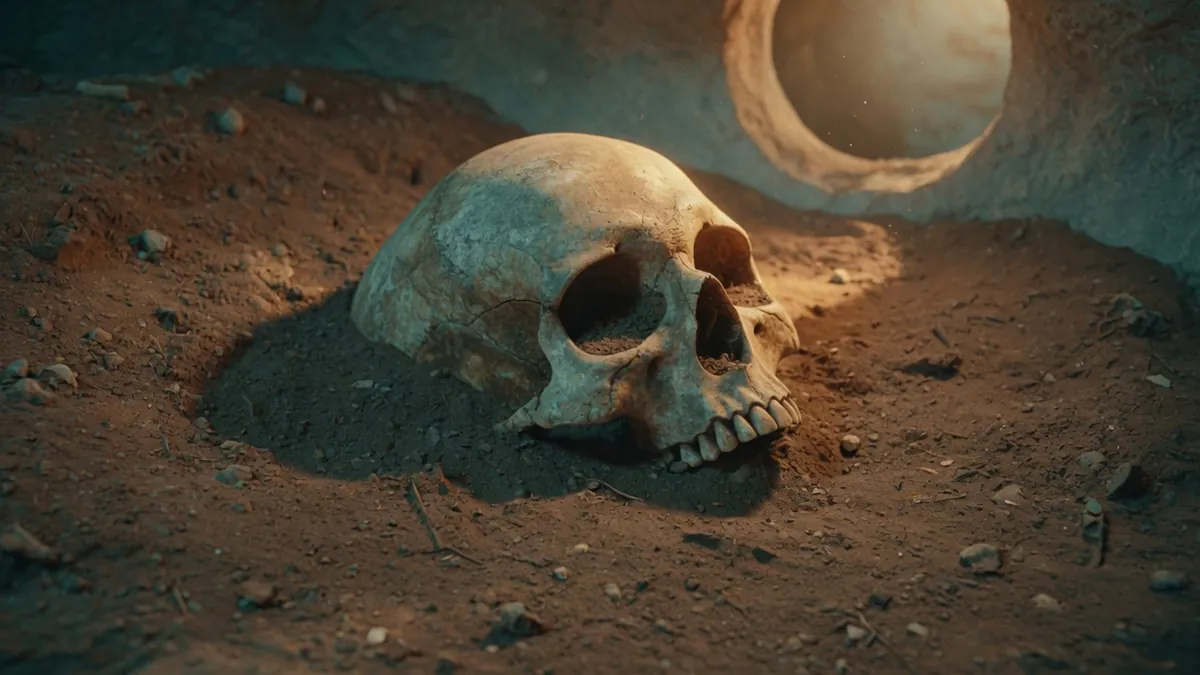
Stone tools survive. Bones survive. Spoken words vanish the instant they are made. That is why the origin of language is one of the hardest questions in all of science, and why honest estimates for when it began range across hundreds of thousands of years. The mystery is not a failure of research; it is built into the nature of speech.
Reading it in the body
Speech needs hardware. Researchers study the hyoid, a small bone that anchors the tongue, and the shape of the vocal tract and larynx, looking for the anatomy that makes complex sound possible. Strikingly, a Neanderthal hyoid bone looks much like ours, one hint among several that our heavy-browed cousins may have had real voices.
Reading it in the genes
Genetics adds another thread. A gene called FOXP2 is essential to normal speech and language; when it is disrupted, speech suffers. It is not a magic 'language gene,' and the full story involves many genes, but here is the twist: Neanderthals carried the same human version of FOXP2 that we do. The biological foundations of speech may be far older than our own species.
Reading it in art
When words fail, look for symbols. A bead, a smear of ochre, a painted animal on a cave wall, none of these is language, but all of them are signs of minds that traffic in meaning, the same kind of mind that names things. As symbolic objects appear deeper and deeper in time, the case grows that language, in some form, is ancient. We may never hear the first word. But we can see the moment our ancestors began to mean.
Sources & further reading
- Enard, W. et al. (2002). FOXP2 and human speech/language. Nature 418; later work showing Neanderthals shared the human FOXP2 variant.
- Arensburg, B. et al. (1989). A modern-like hyoid bone in a Neanderthal (Kebara). Nature 338.
- Lieberman, P. on the vocal tract, the descended larynx, and the evolution of speech.
- Dediu, D. & Levinson, S. C. (2013). On the antiquity of language and Neanderthal speech capacity. Frontiers in Psychology.
- Reviews using symbolic artifacts (ochre, beads, cave art) as archaeological proxies for language.
There is no consensus on when language began; FOXP2 is one of many factors and not a simple switch; Neanderthal speech is plausible but unproven. The uncertainty is presented honestly.
Echoes of Dawn — the story of us, before history was written. Watch the episode and subscribe.