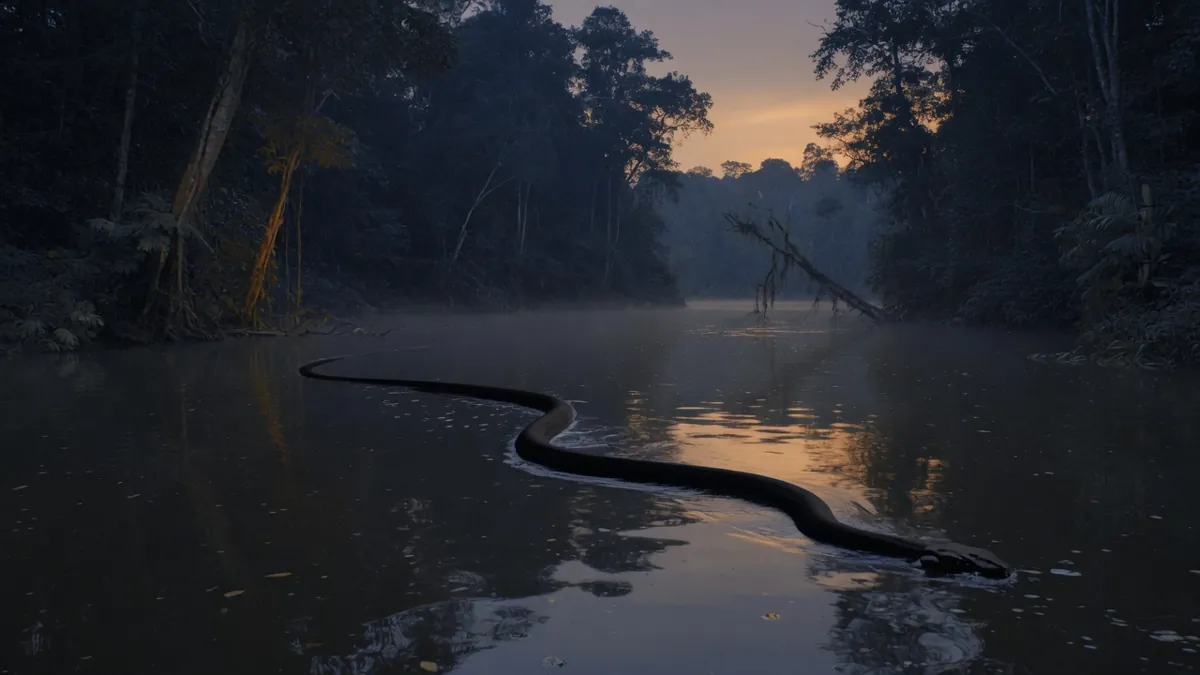
One fossil bone can rewrite history. If that bone is a vertebra larger than a human skull, and it does not belong to a dinosaur, it challenges our entire understanding of prehistoric life. In 2002, coal miners in the massive open-pit mine of Cerrejón in northern Colombia pulled something impossible from the clay: fossilized vertebrae so massive that scientists initially assumed they belonged to a prehistoric crocodile. They were wrong. They had uncovered Titanoboa cerrejonensis—the largest snake in the fossil record, a bus-length apex predator that ruled South America sixty million years ago.
The Empty World After the Asteroid
To understand how a snake could grow to the size of a school bus, we have to look at the world immediately following the Cretaceous-Paleogene extinction event. Roughly sixty-six million years ago, an asteroid struck Earth, wiping out the non-avian dinosaurs and clearing the ecological board. In the quiet, warm world of the Paleocene epoch, the massive reptilian niches were left entirely empty.
While early mammals were still small, nocturnal, and experimenting with basic body plans, reptiles stepped into the vacuum. In the hot, wet swamps of northern South America, one group of constrictors began scaling up at an evolutionary pace that seems almost terrifying. With no large predators to challenge them and abundant prey in the river systems, they grew to sizes that have never been replicated since.
Reconstructing a Giant: The Math of Vertebrae
Paleontologists did not find a complete, intact skeleton of Titanoboa coiled in the mud. Instead, the reconstruction of this ancient giant was a masterpiece of comparative anatomy and mathematics. Led by Jason Head of the Smithsonian Institution and the University of Florida, researchers analyzed thirty individual specimens consisting of one hundred eighty-six fossilized vertebrae.
By using the scaling ratios of modern constrictors—specifically the green anaconda (Eunectes murinus) and the boa constrictor—scientists mapped the size of the vertebrae to total body length. The math revealed an animal that reached an estimated 12.8 meters (42 feet) in length, with some skull-based models pushing toward 14.3 meters (47 feet). It weighed approximately 1,135 kilograms (2,500 pounds)—roughly the mass of a modern compact car.
The Greenhouse Earth and Cold-Blooded Biology
How did biology support a cold-blooded animal of this scale? The answer lies in the paleoclimate of the Paleocene. Reptiles are ectothermic (cold-blooded), meaning their body temperature and metabolic rate are directly regulated by the ambient temperature of their environment. Large ectotherms require significant atmospheric heat to power their metabolic functions.
During the Paleocene, Earth was experiencing a greenhouse state, with mean annual temperatures in equatorial South America reaching between 30°C and 34°C (86°F to 93°F). This intense, stable tropical heat provided the metabolic headroom necessary for Titanoboa to grow, move, digest prey, and sustain its massive bulk. The discovery of Titanoboa served as crucial evidence for climate modelers, proving that the ancient tropics were significantly warmer than today's equatorial regions.
An Apex Predator of the Ancient Waterways
Despite popular culture depicting Titanoboa chasing down early humans or fighting dinosaurs, the reality of its ecology is much more fascinating. The Cerrejón of sixty million years ago was not a dry jungle; it was a massive, slow-moving river delta lined with swampy rainforests, similar to the modern Amazon basin but much hotter.
Titanoboa was a semi-aquatic predator, spending most of its life in the water where its immense weight was supported by buoyancy. Its skull structure, while rare in the fossil record, shows specialized adaptations for catching fish. Rather than hunting large land mammals (which did not exist yet), Titanoboa likely fed on giant lungfish, prehistoric turtles, and massive crocodilians (such as Cerrejonisuchus). It was a silent, underwater current of muscle, strikes, and constrictive force.
The 2024 Challenger: Titanoboa vs. Vasuki
For fifteen years, Titanoboa held the undisputed title of the largest snake ever to slide across the Earth. But in 2024, a team of paleontologists in India described a new contender: Vasuki indicus. Discovered in a lignite mine in Gujarat, India, Vasuki lived during the Middle Eocene, roughly forty-seven million years ago.
Initial length estimates for Vasuki, based on partial vertebrae, range between 11 and 15 meters (36 to 49 feet). While Vasuki may challenge Titanoboa in total length, current scientific consensus suggests that Titanoboa remains the most massive snake in terms of overall body weight and skeletal robusticity. The debate highlights how incomplete the fossil record is and how much we still have to learn about prehistoric giants.
Sources and Scientific References
- Head, J. J., Bloch, J. I., et al. (2009) — "Giant feather-winged and non-feathered constrictor snakes from the Paleocene Neotropics reveal past equatorial temperatures." Nature, 457(7230), 715-717.
- Datta, D., & Bajpai, S. (2024) — "Largest known fossil Madtsoiid snake from the Eocene of India suggests Eocene warmth and long-distance dispersal." Scientific Reports, 14(1), 8054.
- Wing, S. L., Herrera, F., et al. (2009) — "Late Paleocene fossils from the Cerrejón Formation, Colombia, and the earliest Neotropical rainforest." Proceedings of the National Academy of Sciences, 106(44), 18627-18632.
Echoes of Dawn — mapping the ancient paths of life and the events that shaped our modern world.