Your alarm just went off. Before you even open your eyes, you know what time it is, what the weather will be, and what you are going to eat. The modern morning is solved, predictable, and safe. However, fifty thousand years ago, when the first light touched the African savanna, our ancestors woke up to a completely different set of parameters. There were no alarms, no maps, and no safety nets. The morning was a high-stakes transition period: the night predators were retreating, the savanna was waking up, and the day's survival had to be mapped out in the dirt.
For early humans, the first hours of dawn were not for passive rest. Dawn was the most critical planning phase of the day—the moment they gathered their collective intelligence, read the landscape, revived the fires, and made decisions that shaped their evolutionary trajectory.
The Origin of Science: Systematic Tracking at Sunrise
As the sun rose, the savanna was a fresh slate. Overnight, animals had moved, fed, and fought, leaving tracks in the dew-damp mud and dust. To survive, early humans had to read these marks. Anthropologist Louis Liebenberg, who lived and hunted with the San people of the Kalahari, argues that the art of animal tracking is the origin of science itself.
Tracking is not a simple visual reflex. It is a process of systematic, hypothetical-deductive reasoning. At dawn, a tracker observing a print does not just see a shape. They run a mental simulation:
- Identification: What animal made this print, and what was its weight and speed?
- Taphonomy: How fresh is the track? Has the morning dew settled in the depression, or did the wind blow loose sand over it?
- Intent: Is the print deep at the toe, indicating the animal was running, or shallow, suggesting it was feeding calmly? Where was it headed?
This systematic analysis of tracks requires the brain to hold abstract representations of things that are not present. Tracking forced the human brain to develop the logic of cause and effect, forming the foundation of scientific inquiry hundreds of thousands of years before the first laboratories.
| Observational Data | Deductive Analysis | Prehistoric Application |
|---|---|---|
| Dew in print depression | The print was made before the dew fell, meaning the animal passed hours ago. | Ignore trail; the animal is too far ahead. |
| Sharp, damp edges, no dew | The print was made after the dew fell, indicating the animal is very close. | Prepare weapons; proceed with extreme caution. |
Feeding the Hungry Brain: The Fire-Cooking Nexus
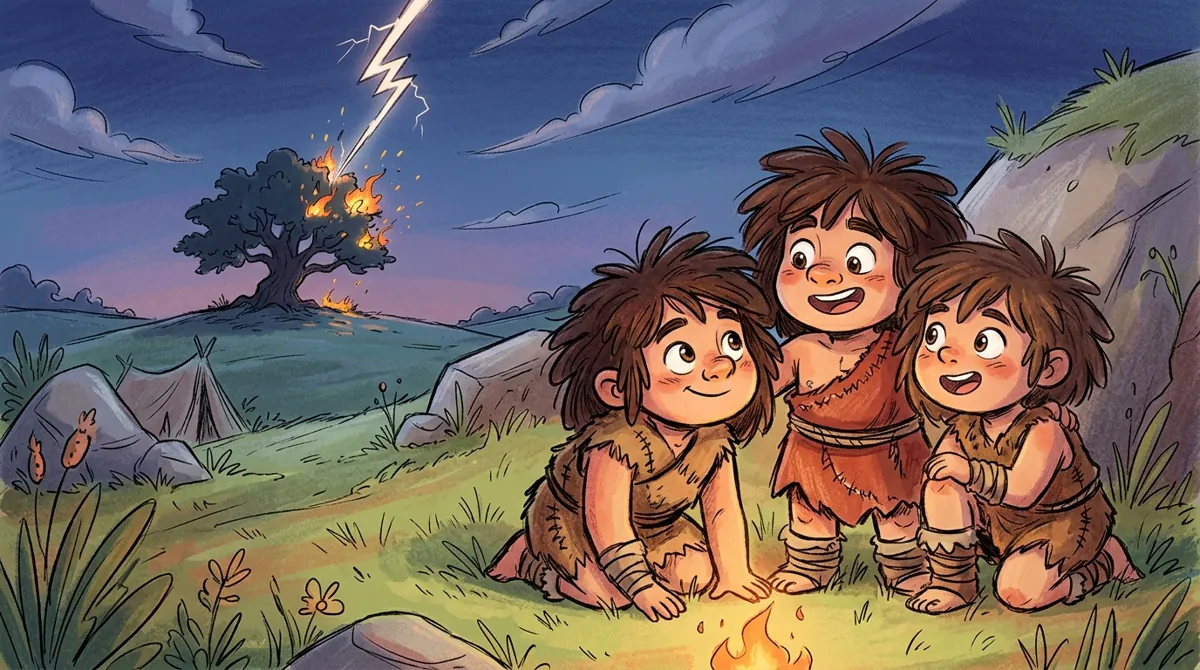
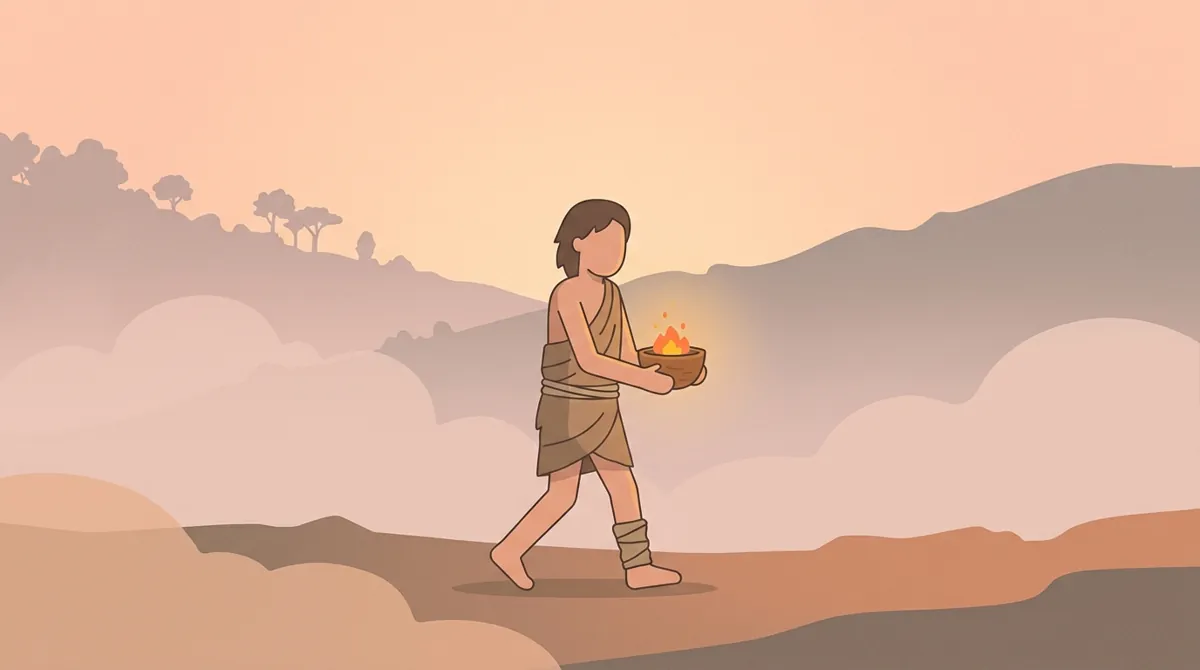
While the trackers read the sand, the first physical task back at the camp was always the same: reviving the hearth. During the night, the fire had shrunk to glowing coals. At dawn, they had to tease it back to life with dry grass and thin twigs. This simple morning chore was the key to our brain's physical growth.
Harvard anthropologist Richard Wrangham’s cooking brain hypothesis argues that the control of fire and the practice of cooking food were crucial for human evolution. The human brain is an incredibly demanding organ—it makes up only two percent of our body weight but consumes twenty percent of our resting energy. A brain that expensive cannot run on raw, hard-to-digest savanna plants and tough meat.
Cooking gelatinizes starches, denatures proteins, and breaks down tough fibers. This pre-digests the food, allowing our gut to absorb up to fifty percent more calories with significantly less metabolic work. By converting fire into an external digestive system every morning, early humans unlocked the dense, high-calorie nutrition required to fuel and grow the human mind.
The Network Mind: Morning Planning and Collective Intelligence
The dawn was also when the group operated as a single, distributed network. As the camp woke, information was shared. Trackers reported fresh prints, others noted water levels, and elders evaluated weather signs. No single brain had to hold all the survival data; it was distributed across the community.
In his book *The Secret of Our Success*, anthropologist Joseph Henrich highlights that humanity’s greatest superpower is not individual intelligence, but our **collective intelligence**. We learn, adapt, and build databases of culture together. At dawn, this collective mind was updated. Decisions were negotiated—where to hunt, when to move, which areas to avoid. This morning planning loop built the tight social bonds and cooperative communication networks that allowed *Homo sapiens* to survive in environments where individuals would quickly perish.
References
- Liebenberg, L. (1990). *The Art of Tracking: The Origin of Science.* **David Philip Publishers**.
- Wrangham, R. (2009). *Catching Fire: How Cooking Made Us Human.* **Basic Books**.
- Henrich, J. (2015). *The Secret of Our Success: How Culture is Driving Human Evolution.* **Princeton University Press**.
- Marean, C. W. (2010). *Pinnacle Point Cave 13B and the origins of modern human behavior.* **Journal of Human Evolution**, 59(3), 234-243.