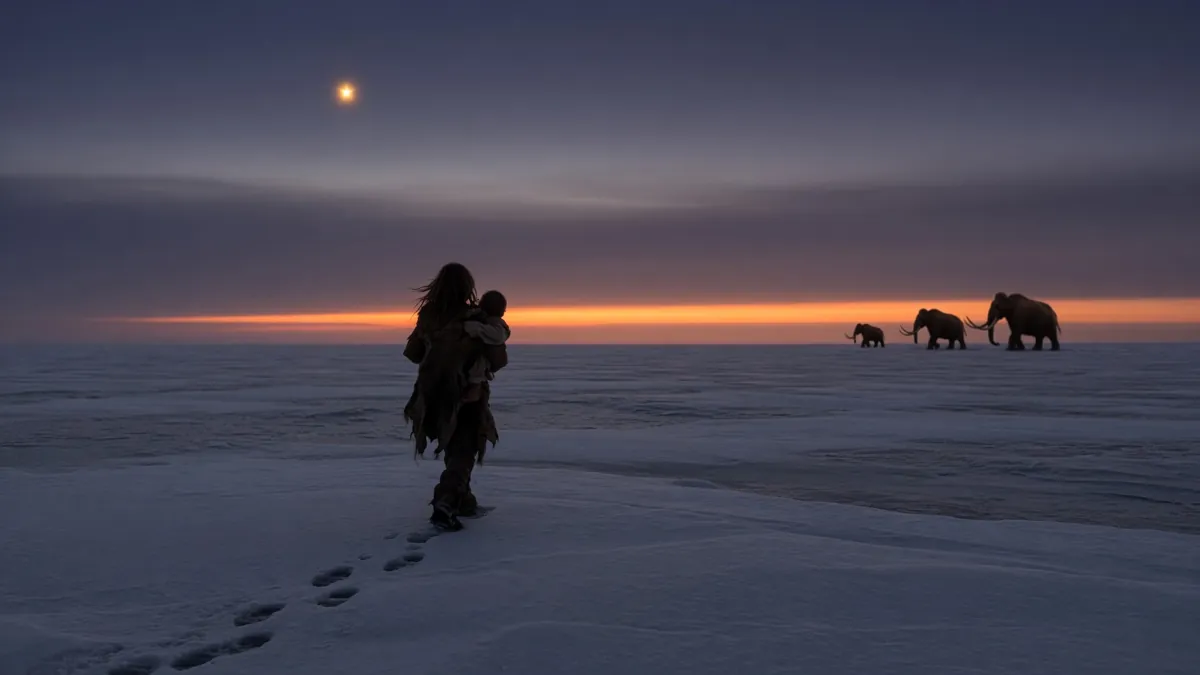
It's three in the afternoon, and your brain has simply stopped. You read the same sentence four times, nothing goes in, and you reach for more coffee while a quiet voice asks the usual question: what is wrong with me? Here is the reframe that changes everything: nothing is wrong with you. When you force yourself to focus for eight unbroken hours, you are fighting something far older than your job, roughly 300,000 years of being human. Your brain was never built for the factory floor. It was built for the hunt.
Bursts of focus, then real recovery
For almost the entire human story, survival did not reward a slow, steady, all-day grind. It rewarded short, explosive bursts of total focus. A hunter reading a single track in the dirt was not multitasking; in that moment every sense narrowed to one point and the body braced for action. Researchers think that kind of acute focus rode a surge of stress and reward chemistry that sharpened the senses to their limit. But here is the part we have forgotten: when the hunt ended, the machine powered down. Our ancestors did not invent busywork or optimize their downtime. They rested, fully. Intensity, then recovery, then intensity again, that was the human rhythm.
Now look at what we built instead. The continuous eight-hour workday is a flat line of constant, low-grade output, lit by hard light and measured by a clock. We took a brain tuned for sprints and asked it to jog slowly, forever. That mismatch has a name in your body: the hollow, foggy crash in the afternoon.
Fire, and the first true rest
To see how strange modern life really is, you have to talk about the dark. For almost all of human history, night meant genuine darkness that lasted for half of your life. Then came one small flame that changed the human mind: fire. A fire is really just a small circle of light and warmth in a vast open dark, but inside that circle the hunted could finally stop being prey. Around it, our ancestors became something new, storytellers and listeners and a gathering. It may have been the first time the human nervous system was allowed to truly, deeply relax.
The night we slept twice
In that long darkness, even sleep looked nothing like yours. The historian A. Roger Ekirch dug through thousands of old diaries, letters and court records and kept finding people describe not one sleep, but two: a "first sleep" soon after dark, then an hour or more awake in the deep of the night (they called it the watch), then a "second sleep" until dawn. People used the gap to pray, talk, think, even visit a neighbour. Waking at night was simply normal.
Is that just old folklore? In the early 1990s the psychiatrist Thomas Wehr tested it, keeping volunteers in fourteen hours of darkness every night, like a long winter. Within weeks their sleep split cleanly into two blocks divided by a calm, wakeful hour. So if you have ever jolted awake at two in the morning convinced your body is broken, it may simply be remembering an older pattern surfacing in the dark.
The honest twist
But credibility matters, and this is where it gets interesting. When scientists studied people who still live close to that ancient world, the Hadza of Tanzania, the San of Namibia and the Tsimané of Bolivia, they found a surprise (Yetish and colleagues, Current Biology, 2015): those communities mostly sleep in one solid block of around six and a half hours, with very little insomnia. So "two sleeps" may be less a fixed human default and more what long, dark nights draw out of us. The deeper lesson was never really about how we sleep. It is about rhythm: our ancestors lived by waves of energy and rest, and we replaced those waves with a straight line.
How we conquered the night, and kept the rhythm
We did it astonishingly recently. In the year 1667, by royal decree, Paris became one of the first cities lit by ordered public lanterns. Lamp by lamp we pushed back the night, and with it the old rhythm; today we trade a sky full of stars for the cold blue glow of a screen minutes before sleep. And yet that ancient pulse never left you. Your focus still arrives in waves. The sleep scientist Nathaniel Kleitman described a cycle of roughly ninety minutes, his Basic Rest-Activity Cycle, that runs even while we are awake: about an hour of sharp attention, then a dip when the mind goes foggy and asks for a pause. That dip is not weakness. It is the tide going out, exactly as it was meant to, and fighting it with caffeine and willpower means arguing with hundreds of thousands of years of biology.
Rest is a requirement, not a reward
So the fix is not a new app or a little plastic timer. It is older and simpler: work in bursts, then rest without guilt, and treat recovery not as a reward for productivity but as a requirement for it. Give yourself, now and then, the same stillness our ancestors found around the fire. Which leaves one real question. Are you managing your time, or are you fighting your evolution?
Sources and further reading
- A. Roger Ekirch, At Day's Close: Night in Times Past (2005) — pre-industrial "first" and "second" sleep.
- Thomas A. Wehr, "In short photoperiods, human sleep is biphasic," Journal of Sleep Research (1992).
- Yetish et al., "Natural Sleep and Its Seasonal Variations in Three Pre-industrial Societies," Current Biology (2015) — Hadza, San, Tsimané.
- Nathaniel Kleitman — the Basic Rest-Activity Cycle (~90-minute waking ultradian rhythm).
- History of Paris public street lighting, 1667 (Louis XIV; police chief Gabriel Nicolas de la Reynie).
Note: this is evolutionary and historical context, not medical or psychological advice. Segmented sleep is documented for pre-industrial Europe and in Wehr's experiment, but contemporary foragers mostly sleep in a single block, so it is best understood as what long dark nights can elicit rather than a universal rule.
Echoes of Dawn — the story of us, before history was written. Watch the episode and subscribe.