Every four years, billions of humans gather around screens and stadiums to watch the same basic event: two teams, a ball, a boundary line, and a way to win. The modern spectacle of the World Cup feels like the peak of contemporary organization—engineered by satellites, sponsors, and global media. But if you strip away the screens and plastic seats, you are left with a ritual that is far older than writing. We did not invent this game in the modern era; we re-invented it. Across oceans and millennia, civilizations that had absolutely no contact with one another sat down and built the exact same game.
Mesoamerica: The Solid Rubber Arena
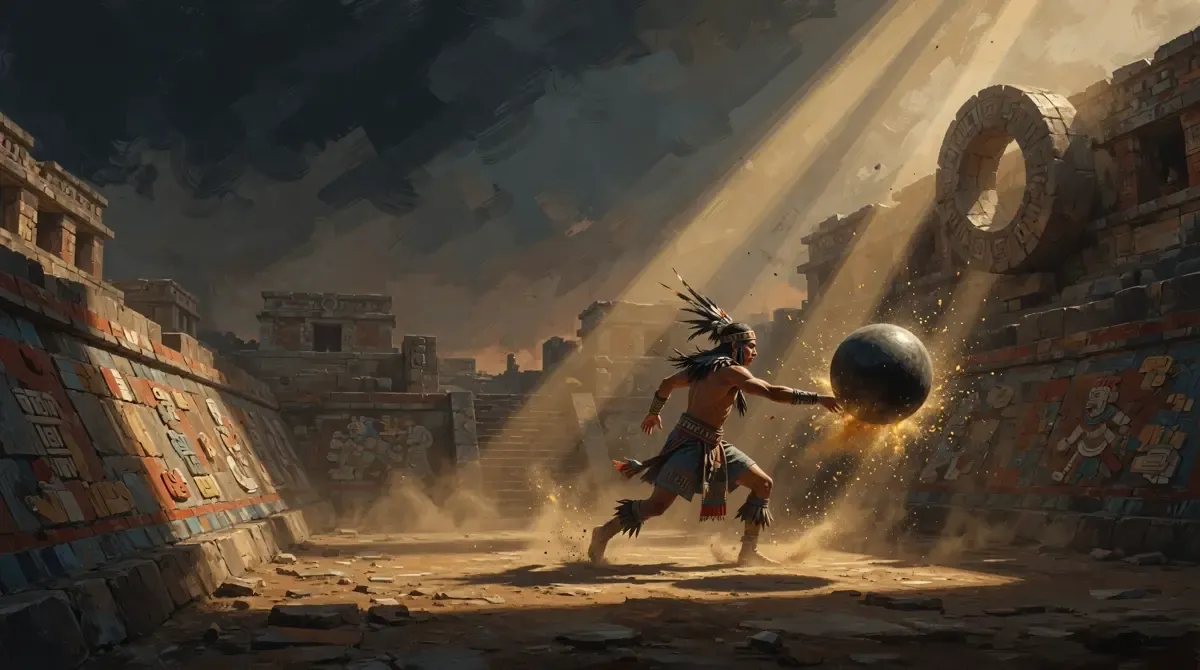
Our journey into deep time begins in the wetlands of ancient Mexico. In a sacrificial bog named El Manatí, archaeologists uncovered twelve solid rubber balls preserved in the anaerobic mud. Radiocarbon dating placed these artifacts at roughly 1600 BCE—the oldest evidence of rubber production on the planet. These springy, heavy balls belonged to the Olmec civilization, a people who had unlocked the chemistry of tapping trees and vulcanizing sap centuries before Western science.
To go with these balls, Mesoamericans built stone arenas with sloping walls. The game, known in Nahuatl as ōllamaliztli, was played across hundreds of ballcourts for over three thousand years. Players struck a solid rubber ball—which could weigh as much as a modern bowling ball—using only their hips. It was a brutal, bruising game, and the stakes could be cosmic. Carvings show players being sacrificed, though historians debate whether these rituals targeted the winners, the losers, or captured soldiers. The game survived the Spanish conquest and is still played today in parts of Mexico under the name ulama.
Ancient China: The Birth of Cuju
While players in Mesoamerica were striking rubber with their hips, people on the other side of the planet were kicking a stuffed leather ball through a hole in a net. In ancient China, this game was called cuju (literally "kick-ball").
By the Han dynasty, over two thousand years ago, cuju had evolved from a casual pastime into a standardized sport with official rules, rectangular courts, and professional teams. Han emperors watched matches, military generals used it to train soldiers, and cities celebrated star players. The game became so popular that in 2004, FIFA officially recognized cuju as the oldest known form of football, confirming that the roots of the world's game were Chinese, not English.
Greece and Rome: Episkyros and Harpastum
In the Mediterranean, the same blueprint emerged. The ancient Greeks played episkyros, a game where two teams faced off across a center dirt line (the skyros). The objective was to throw and kick a ball over the opponent's boundary line while defending your own. It was a high-contact game that allowed the use of hands and full-body tackling.
The Romans took the Greek rules and engineered a rougher version called harpastum. Played with a small, hard ball, harpastum resembled a muddy, chaotic mix of rugby and wrestling. The famous Roman physician Galen actually recommended the game in his writings, calling it the perfect exercise because it cost nothing, kept the body agile, and trained the mind in tactics.
Medieval Europe: Mob Football and the Royal Bans
By the Middle Ages, the game had evolved into what can only be described as village-wide chaos. Across England, towns engaged in **mob football**. There were no limits on team sizes, and the goals were often located at opposite ends of the town. Hundreds of people would chase a single ball through streets, fields, and rivers, shoving and tackling for hours.
The game was so disruptive and violent that kings repeatedly tried to outlaw it. In 1314, King Edward II issued a royal decree banning football in London on pain of imprisonment. Yet, the people refused to stop. Between 1314 and 1667, England banned the game more than thirty times. The crown outlawed the ball, but the human drive to play kept winning.
The Science of Play: Why We Can’t Stop
Why does the human brain keep re-inventing this game? Look at our children: no one teaches a toddler to run after a rolling ball. They do it instinctively. In fact, the oldest known ball in the world is a child's toy—a bundle of linen rags tied with string, recovered from an Egyptian grave dating to 2500 BCE, excavated by the pioneer archaeologist Flinders Petrie.
Play is not a waste of energy; it is an ancient evolutionary adaptation. Ethologists like Gordon Burghardt have shown that play is common across many animal lineages. For young predators, play is a safe, low-stakes rehearsal for hunting and fighting. For humans, team sports are a safe rehearsal for collective action. A ball game allows us to practice coordination, test our physical limits, and establish social hierarchies—all without the lethal consequences of war.
The game we watch today is older than writing. It has been with us since the dawn of our species. It is a biological reflection of who we are: the running, throwing, playing ape.
Sources & Further Reading
- Ortíz, P. & Rodríguez, M. C. — Archaeological reports on the Olmec rubber balls of El Manatí, Veracruz.
- Blomster, J. P. & Salazar Chávez, V. E. (2020) — "Origins of the Mesoamerican ballgame: earliest ballcourt from the highlands found at Etlatongo, Oaxaca." Science Advances.
- FIFA Museum — "Origins of Football: Cuju in China and Mesoamerican ball games."
- Attempts to Ban Football Games — Legal history of medieval English decrees and the attempts to regulate mob football (1314–1667).
- Burghardt, G. M. — The Genesis of Animal Play: Testing the Limits (MIT Press).
Method note: Archaeological interpretations of ancient games, especially the rules and ritual contexts of Mesoamerican ball games, are based on surviving iconography and accounts, which remain subject to debate. Treat reconstruction of specific rules as highly probable but not absolute.
Echoes of Dawn — documenting our deep-time origins, human evolution, and the archaeology of our shared past. Watch the episode and subscribe.